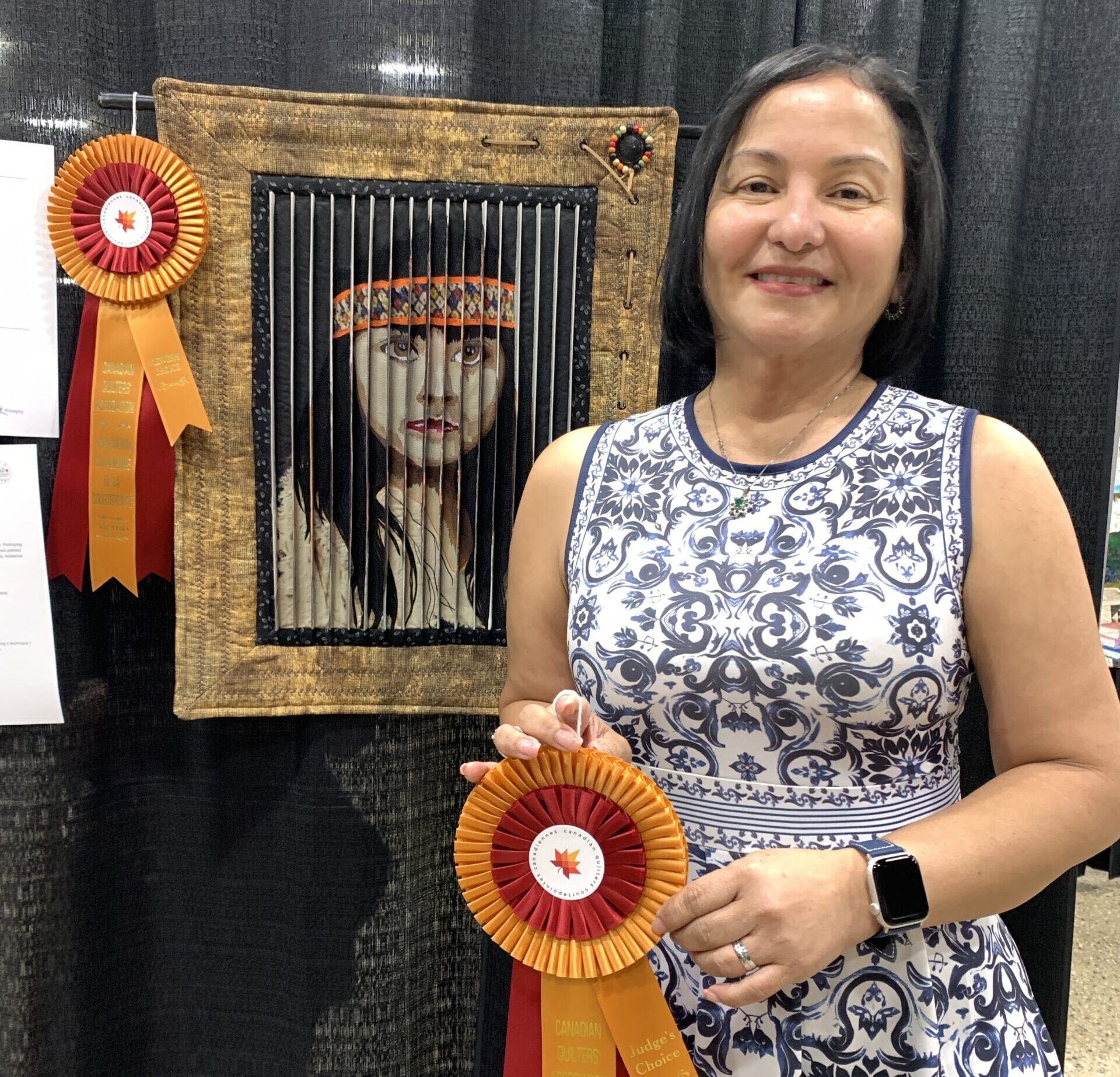
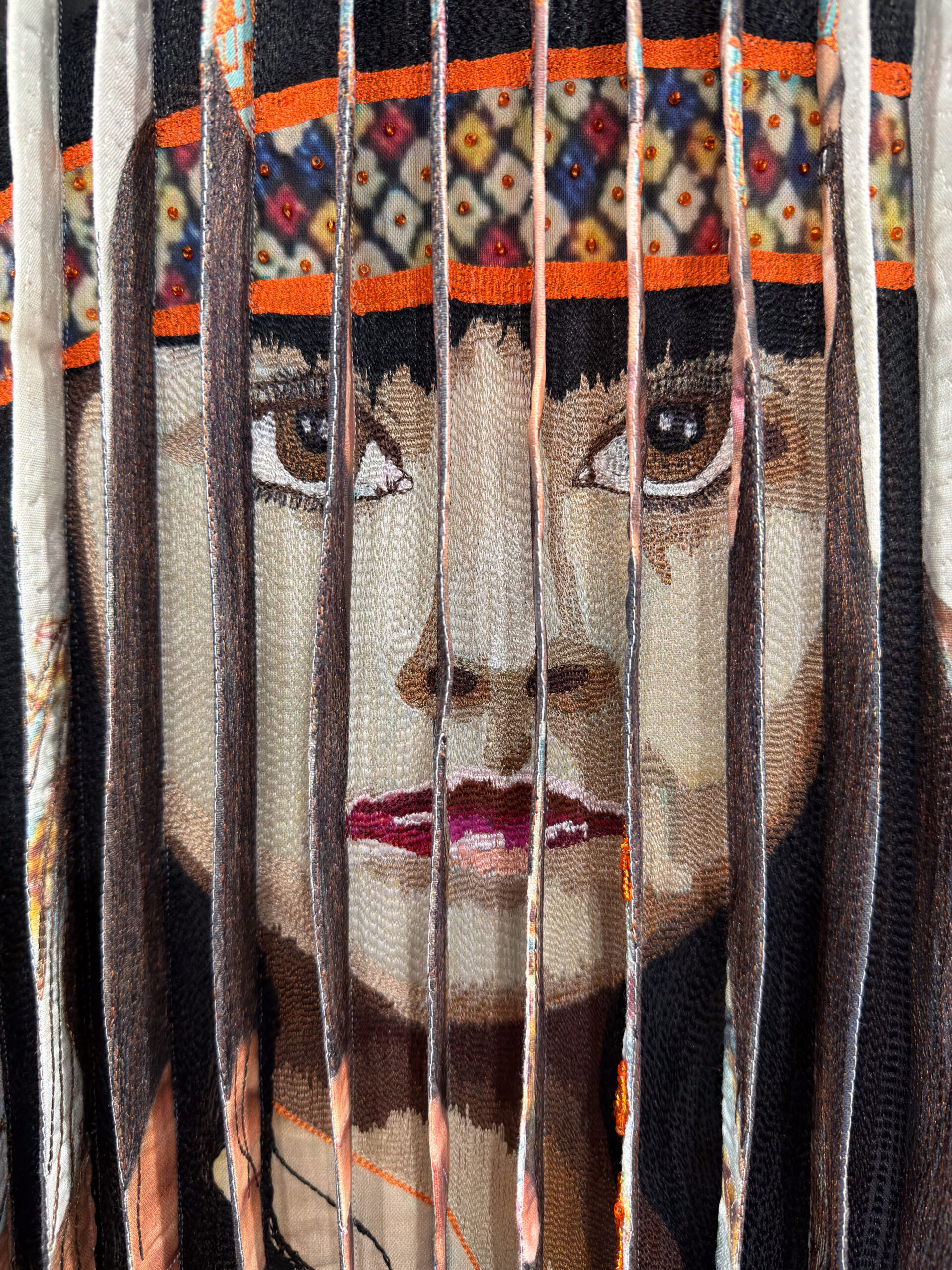
“Watch this,” the white-gloved volunteer said as a woman walked up to Every Child Matters. After inspecting the thread-painted image of a young girl, she began to walk away then did a double take.
From just one step to the right, she suddenly saw a different face. Two steps to the left, another image leapt to life. Her face lit up as she moved back and forth, her brow furrowed with unanswered questions.
(Click on the arrow to activate the video so you can see all three faces.)
Such was the magical interaction that earned Esperanza Aldrich the Viewers’ Choice Award within the National Juried Show (NJS). The previous evening, she learned that Certified Quilting Judge Rebecca McAlpine had chosen her work as her Judge’s Choice.
This quilt devoted to her youngest daughter drew the most curiosity during her time at Quilt Canada. As the judges offered guided tours, they invited her to join in more than a dozen times.
Esperanza drew her inspiration from a centuries-old multi-image technique seen in Gaspar Antoine de Bois Claire’s 1692 portrait, later expanded by Yaacov Agam. Their three- and four-image works first introduced her to these possibilities.
She learned about this effect from Flora Joy at Houston International Quilt show 13 years ago and from Sue Hickman via YouTube. Yet, the design and technique are hers alone.
Every Detail Matters
Esperanza and her husband Cameron adopted their niece’s baby girl Alajandra at age five months. Now 16, Alajandra is a talented artist whose drawings already inspire her mother’s dreams of her next quilt.
“I wanted to tell her story in three pictures,” Esperanza said, choosing samples from ages four, 10 and 13.
After making them the same size, she created paper versions as she went through trial after trial to get it right. She quickly learned that having a black background for all three didn’t give enough contrast, switching to light ones for the two on the sides.
Each picture is cut into 16 strips; the first one is flat while the second and third images are glued at 90-degree angles on strips that stand out from the quilt’s surface.
“I cut, glued, scanned and printed the strips,” Esperanza said. “I made many mistakes and now know you need the same number of columns.”
Over and over, she made sure the sections aligned perfectly.
Next, she went looking for fabric that looked like leather to complement the textures within the images. When she finally found it, she bought five metres but only used half of one. (We can all relate, right?) The final piece is 20 by 25 inches.
She spent hours learning how to thread-paint Alajandra’s long hair, eyebrows and other facial features, especially in the central image. Finally, it took her nine months to quilt all three sections sequentially while laying them flat – squeezed between demands from work and her family.
Finally, she added three leather strings of beads on the right-hand side. And entered the NJS for the first time.
Every Child Matters
The piece’s title says so much. It honours Indigenous children and the legacy of residential schools. By portraying her daughter, Esperanza grounds this history in lived experience. She deliberately used orange thread in the main image’s headband in relation to Indigenous truth and reconciliation.
“This piece expresses remembrance through layered stitching, affirming every child’s dignity, resilience and future,” she wrote in her artist’s statement.
Alajandra could have ended up in the foster care system but she lives within her extended family. This quilt speaks to the love for her.
The awards just add to her enjoyment of the piece. It had already won awards in Brazil and Calgary as well. She also plans to show it at the Central Alberta Quilters Guild show in Red Deer, where she is a member. She has already shared her other award-winner from Quilt Canada at its previous show. (See below.)
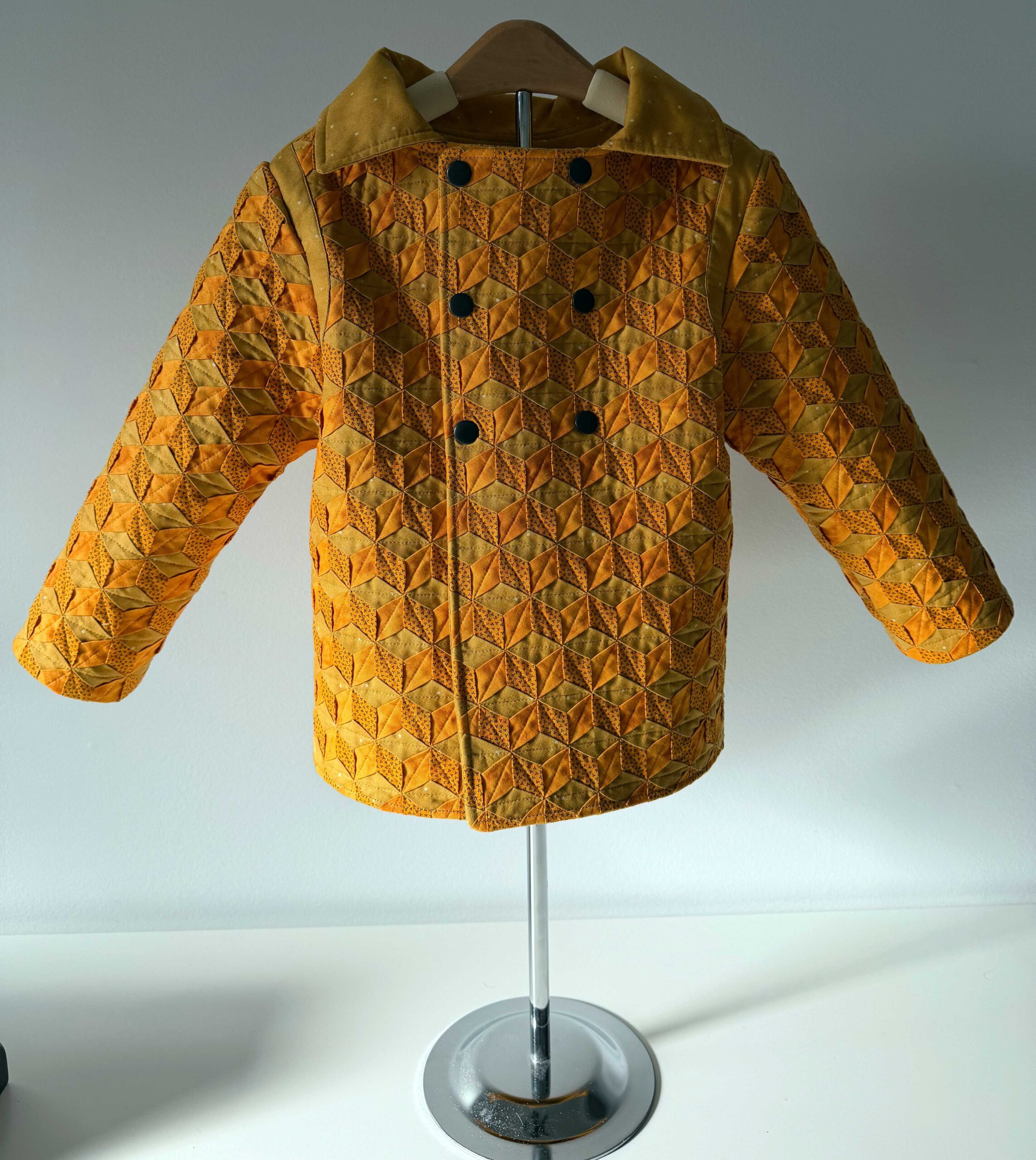
Also, her child’s jacket Cotton Hug placed third in Wearables. This yellow jacket explores structure and form through textile construction.
The weaving is folded back on itself to create two layers per strip resulting in four layered surfaces that add body and dimension. The stitching subtly defines shape while visually pleasing.