
Can you name six styles of quilts made by Canada’s pioneers? For a look at their ingenuity and creativity, join a lecture on Saturday, Sept. 26.
The Canadian Society of Decorative Arts (CSDA) hosts Lisa L. Binkley, author of Canadian Quilts and Their Makers: Design, Material and Place in the Nineteenth Century. The book comes out on Oct. 15 so this session provides a sneak peek at what’s inside. In-person ticket holders can purchase copies of the book for $39.95 while at the Arts & Letters Club, 14 Elm Street, Toronto. They can also enjoy coffee, tea and pastries.
Canadian Quilts and Their Makers will take place from 11 a.m. to 1 p.m. (Eastern time). However, quilters can listen in virtually for a reduced fee. Tickets cost $20 to $25 for in-person attendance and $10 to $15 for a virtual pass. The lower prices apply to CSDA members and viewing parties are in the works if your group wishes to arrange one.
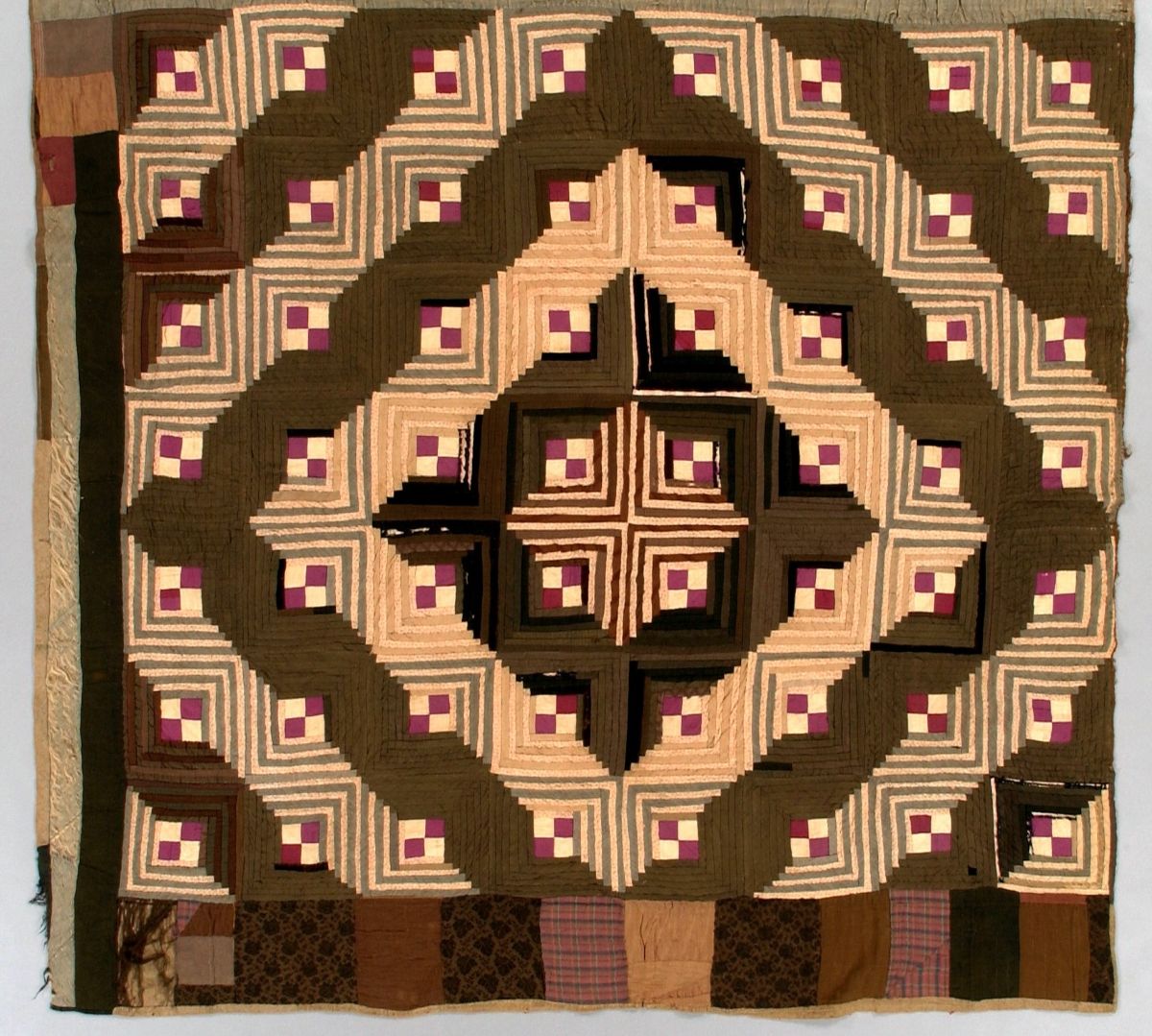
During the session, Lisa will talk about quilts like the one pictured here by Janett Vanalstine. Her Barn Raising Variation, c. 1970, was made with silk, velvet and cotton in Lennox and Addington County, Ontario. At 162.5 x 178.0 cm, it belongs to the Canadian Museum of History’s McKendry Collection, 2001.188.626.
Six styles of quilts
Naturally, quilts kept people warm during long Canadian winters when they had fewer conveniences. Yet, Lisa’s lecture highlights how their makers expressed creativity from the Great Lakes to the Maritimes between 1810 and 1880.
She explores a range of quilt styles to reveal the social, cultural and economic experiences of 19th-century makers and users:
- appliqué
- crazy
- decorative-utilitarian
- embroidered
- homespun-utilitarian
- whole cloth
Meanwhile, their techniques evolved due to technological improvements. For example, new forms of transportation, like the railway and steam-powered ships, provided access to affordable textiles and new patterns. Factory-made cloth, less strenuous working conditions in the home print media also opened new doors for sewists from that era.
As settlement extended west from the Maritimes to the Prairies, quiltmakers drew inspiration from their surroundings.
The quilts presented offer a glimpse into Canada’s quilt-making history and its relationship to European influences. Further, Lisa will also discuss how to read quilts as documentary evidence. She will unravel often overlooked aspects of Canadian women’s daily, domestic, and design histories.
Her book also examines how quilting reflected the experiences and identities of the women who made them. The textiles and methods demonstrate how their makers adapted to broader changes in society. Despite social constrictions on women, the quilts they made and exchanged reveal fascinating, nuanced ideas about colour, design, and politics.
Lisa has also published the following books:
- 500 Art Quilts, Lark Books, Spring 2010
- Creative Quilting with Beads, Lark Books, Spring 2008 (3 quilts in book)
- Fiberarts Design Book 7, Lark Books, Spring 2004
- Quilts and Health, Indiana University Press, 2018