
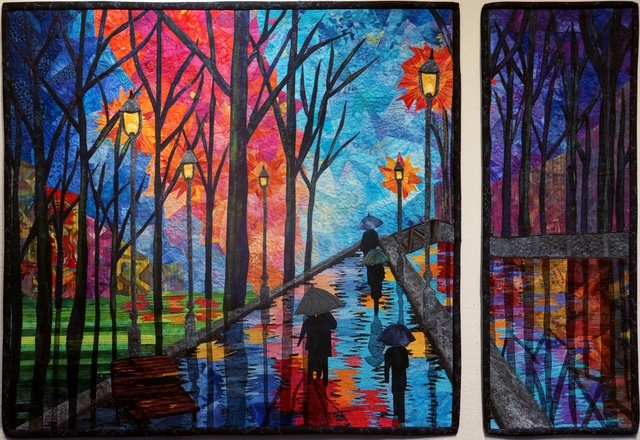
After seeing each winner’s work at Quilt Canada 2025, we asked how they take designing a quilt from good to great. In this case, R. Leslie Forbes’ Lamplights in the Gloaming earned third place in Art | Landscapes and Still Life.
Light, shadow and colour fascinate me and I am drawn to these aspects when designing a quilt. Reflections play a major role in this evening street scene, which is an original design.
Artist Paul Cezanne wrote that “A work of art that does not begin with emotion is not art. Emotion is the starting point, the beginning and the end. Craftsmanship and technique are in the middle.”
These words on my design wall remind me if I do not connect to my art then I will not connect with the viewer.
I often say that “I play,” yet I fall back on the rules of design when I struggle. It is the challenge of finding a solution which brings me joy in the process. There is no solace or peace in the creative process. Art in all its forms is a struggle: exciting, rewarding, enriching, frustrating and even offering contentment at times.
Themes of landscape, architecture and nature recur when designing a quilt. Colour, line and texture excite me. I find no greater joy than exploring these, whether from photographs from my travels or improvising on my design wall.
Currently, I dye or paint fabric to achieve a larger palette of colour and texture. I am obsessed with exploring reflections and layering in my artwork. These features draw the eye to the movement and depth created with silk and wool roving, organza and tulle.

Exploring light, colour and reflection
Lamplights in the Gloaming stands as the sixth piece in my series exploring light, colour and reflection. I start designing a quilt with a series of drawings. When I like a concept, I redraw it on 3M “write-on transparency film” using a black fine-point Sharpie marker.
Using my overhead projector, I can adjust the drawing to the appropriate size on my design wall. I prepare the wall first with a layer of Turban Cloth (a very lightweight cloth to fuse the fabric to) and white freezer paper. The drawing on the freezer paper will eventually become my patterns. I use the word pattern lightly as I am always adjusting in the creative process.
Next, I choose my colour palette based on pure emotion. I work intuitively and usually end up with multiple options on my cutting table. Hours will pass by as I play and curate.
With a colour palette selected, I back them with a fusible, using whatever material will bring my vision to life. As visual artists, we question our work at various stages in the process. Often a design does not work as I visualized it in my head so I wonder if I should abandon my choices.

Turning to help from FAN
Questions always arise and these kept repeating themselves throughout in “Lamplights in the Gloaming.” Could the buildings and the trees be more abstract than realistic? How would the trees and lamplights coexist as both are very strong vertical elements? Is there enough balance with light and dark elements? Once the piece was machine quilted and back on my design wall, the question was where should I crop it?
On Friday, a group of fabric artists meet via Zoom for Open Studio Day, including many Fibre Art Network (FAN) friends. I posted the question about where to crop and, of course, opinions flowed.
I tried several of the ideas suggested until we reached a consensus. Moving the smaller rejected piece to the right, I remained reluctant to discard it. Instead, I moved it just two inches to the right of the larger section. I now had a diptych!
However, looking closely, I discovered that the tallest lamppost creates an optical illusion that the full work in a triptych. In these moments, my skills matching those flowing ideas and my heightened emotions keep me returning to my studio.
Sharing my art reveals myself. It opens me to both positive and negative comments as we all bring our experiences and emotions when viewing art. Through this journey, I am blessed to have the opportunities to share my work.
Art in all its formats enriches society. As a living presence, it connects a bridge and opens doorways into memory.
Tips to fellow artists
- Create a design wall as large as you can achieve in your space.
- Play with many possibilities and solutions when creating.
- Organize your threads by colour adjacent to your sewing machine, if possible.
- Take multiple photographs and create a reference library. Also, save old calendars as they provide excellent photos for reference.
- Join a group or guild which will support you in your journey.
- Give yourself grace to make mistakes as these are learning opportunities.
- Take classes and attend workshops to learn techniques and improve your skills.
- Create a library of books for reference.
- Study with teachers whose work you admire.
- Do the work! Be brave and enter a juried show.
Teachers who helped me find my voice
- Ruth Mc Dowell
- Jane Sassaman
- Nancy Crow
- Caryl Breyer Fallert-Gentry
- Katie Pasquini Masopust
- Esterita Austin
- Coreen Zerr
Leslie Forbes is a Fibre Artist Living and Working in Osoyoos, B.C.