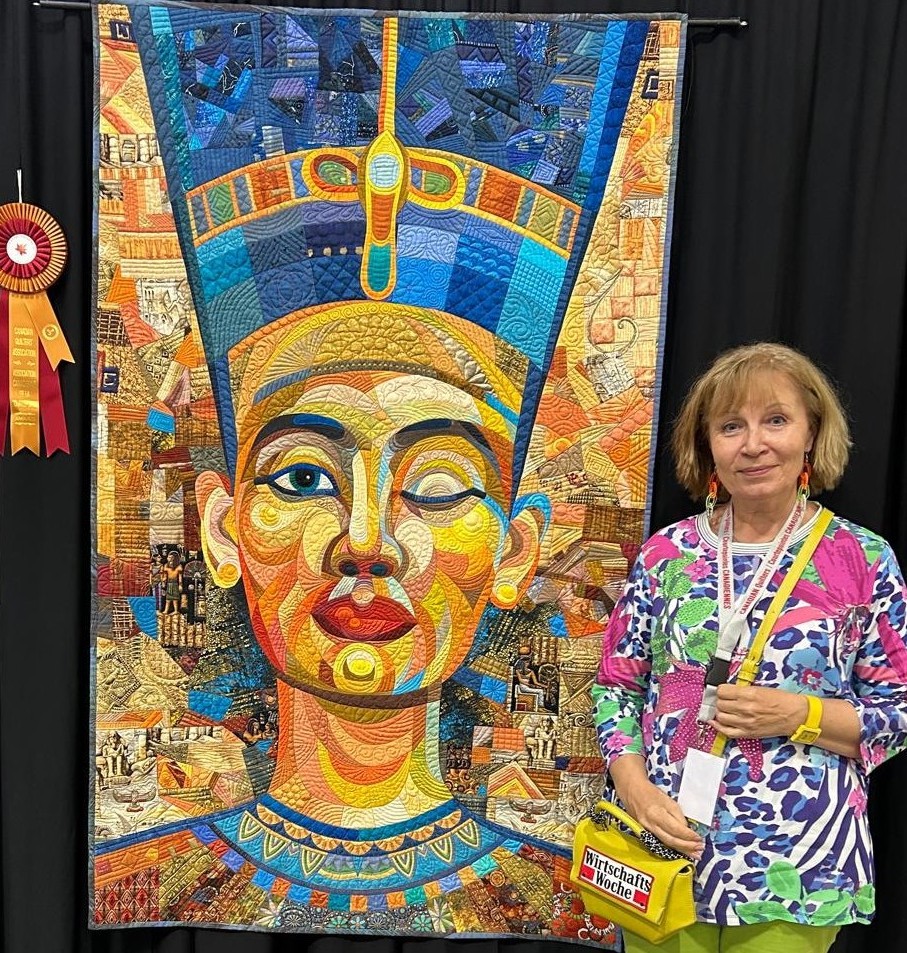
In 2017, I began a large series called “The Women’s Encyclopedia.” It included mythological and imaginary figures: goddesses, muses and fairies. Over time, I wanted to add quilts about real women who had left a vivid mark on world history, focusing on women who had reached the same level as men.
I have always been fascinated by Ancient Egypt, especially the female pharaohs, so I selected three of the most significant figures. So far, I have realized one — Nefertiti — Great Royal Wife of Pharaoh Akhenaten of the 18th dynasty. When I presented her to the public at Quilt Canada, clearly my experiment had succeeded so I will continue on.
The creative process
Where do I begin? I studied every source I could find about my heroine. The Internet is my greatest assistant! I researched, collected images, photographs and previous artistic interpretations to avoid repeating someone else’s idea. Instead, I sought my own unique embodiment.
Studying Nefertiti’s biography, I searched for a detail to anchor my story. Known as the most stunning woman of Ancient Egypt, her name translates as “The Beautiful One Has Come.” Many considered her the living embodiment of the life-giving sun. Most images show her wearing her famous tall blue crown, wrapped with golden ribbons and adorned with the uraeus. This symbolizes her link with the goddesses, daughters of the Sun.
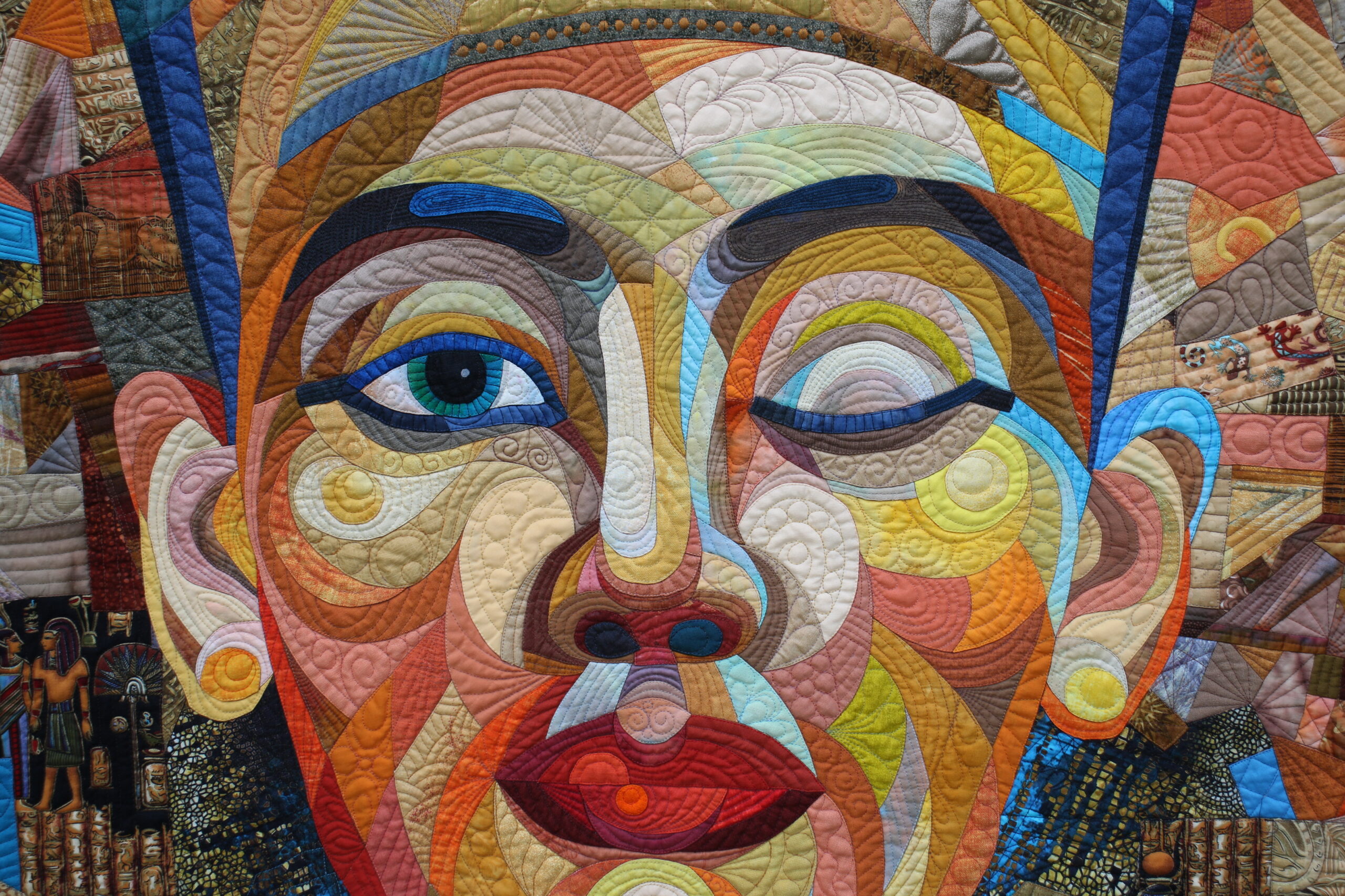
In 1912, archaeologists discovered her famous bust, almost perfectly preserved, except for one detail. The left eye was missing its crystal inlay.
Why? One theory suggests that with two intact eyes, the statue becomes a soul transferred to another world rather than an image. Another connects the missing eye to beliefs in rebirth. A third proposes a medical reason: she may have lost her eye due to illness.
Since no one knows the true reason, I created my own solution. I chose to cover her eye. This gave the work a second visual focus and created the impression that Nefertiti was winking. It also added charm and playfulness to the image.
The making of this quilt about a real women
As the image took shape in my mind. I surrounded myself with photographs from different angles and drew a sketch. When you clearly see the final result in your imagination, the process goes quickly. Within a couple of hours, I had already drawn her head. I transferred it to a larger scale and prepared the pattern. Then I selected the color palette.
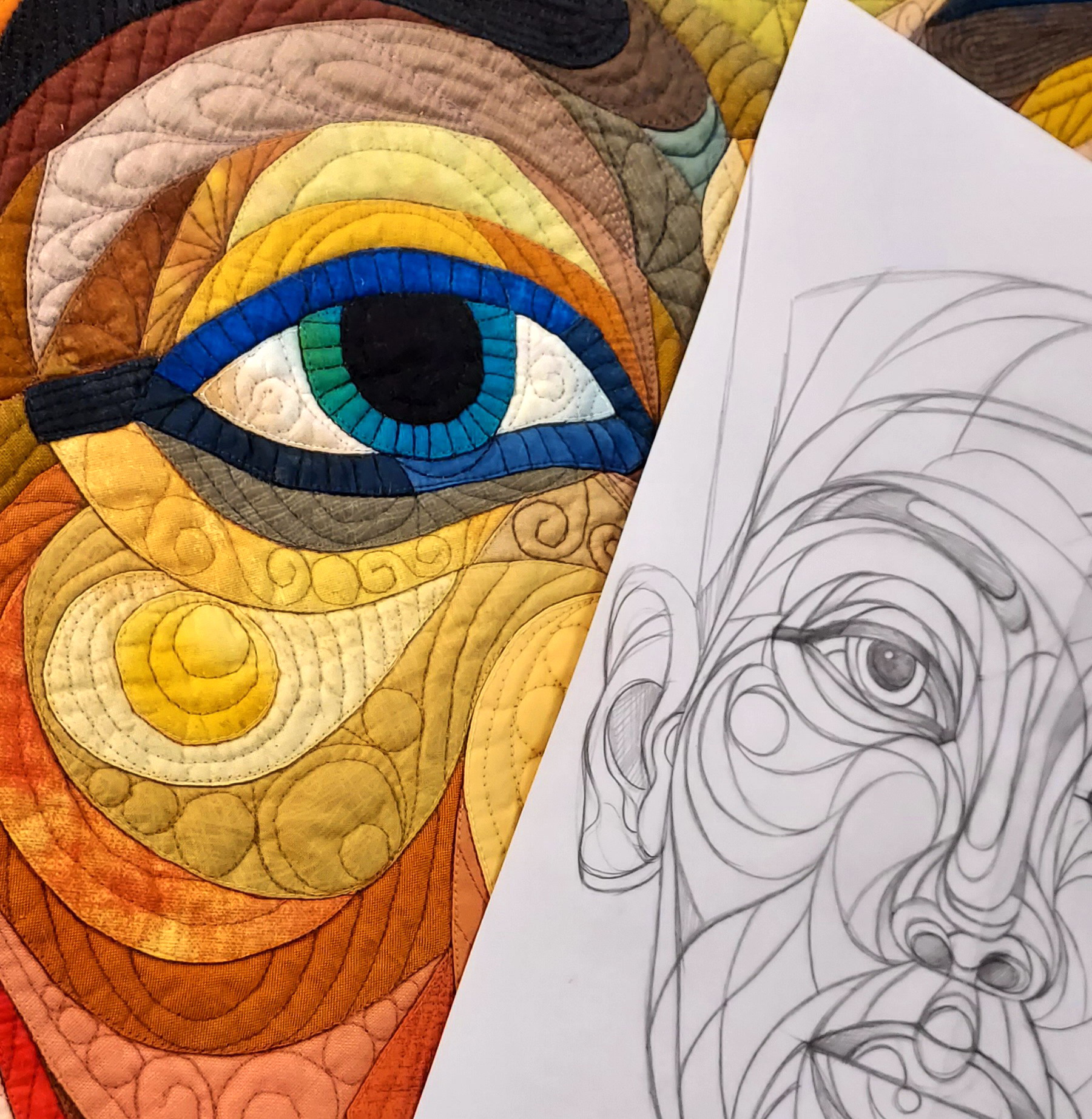
Ancient Egyptian art was filled with magic: simple materials and monumental geometric forms created an impression of grandeur. I applied the same principles: the elongated neck and tall crown visually enlarged the scale of the figure.
The next step took a month of assembling the colourful fragments and building the background. After all, it had to transport the viewer into the epoch of Ancient Egypt. For this, I used fragments of fabrics with Egyptian prints to create a quilt about a real woman.
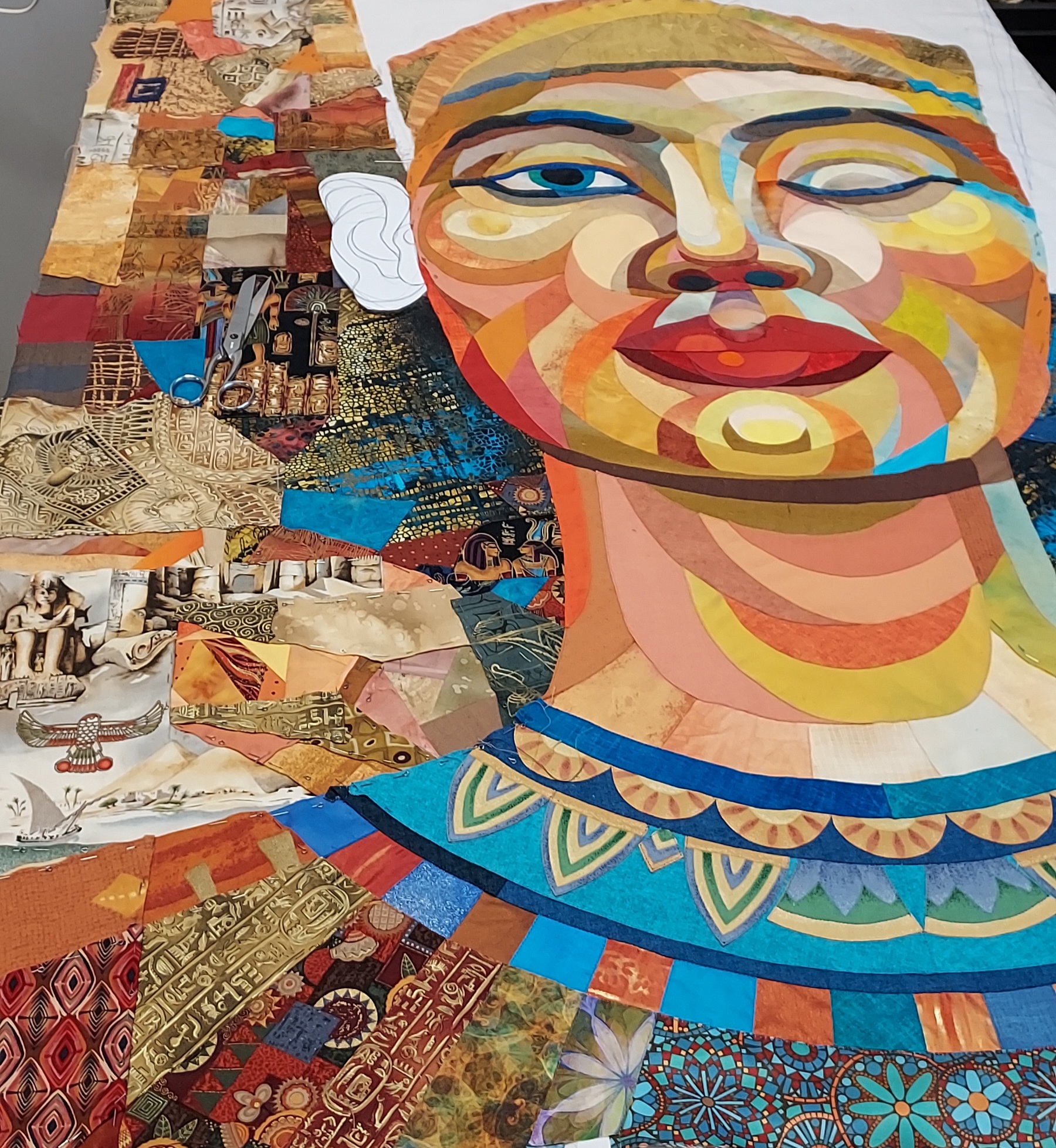
The dominant colour scheme is warm gold, consistent with the title The Golden Age. But I also introduced strong blue accents, symbolizing the sky and the soul’s eternal home, above the earth. This contrast enriched the harmony and depth of the piece.
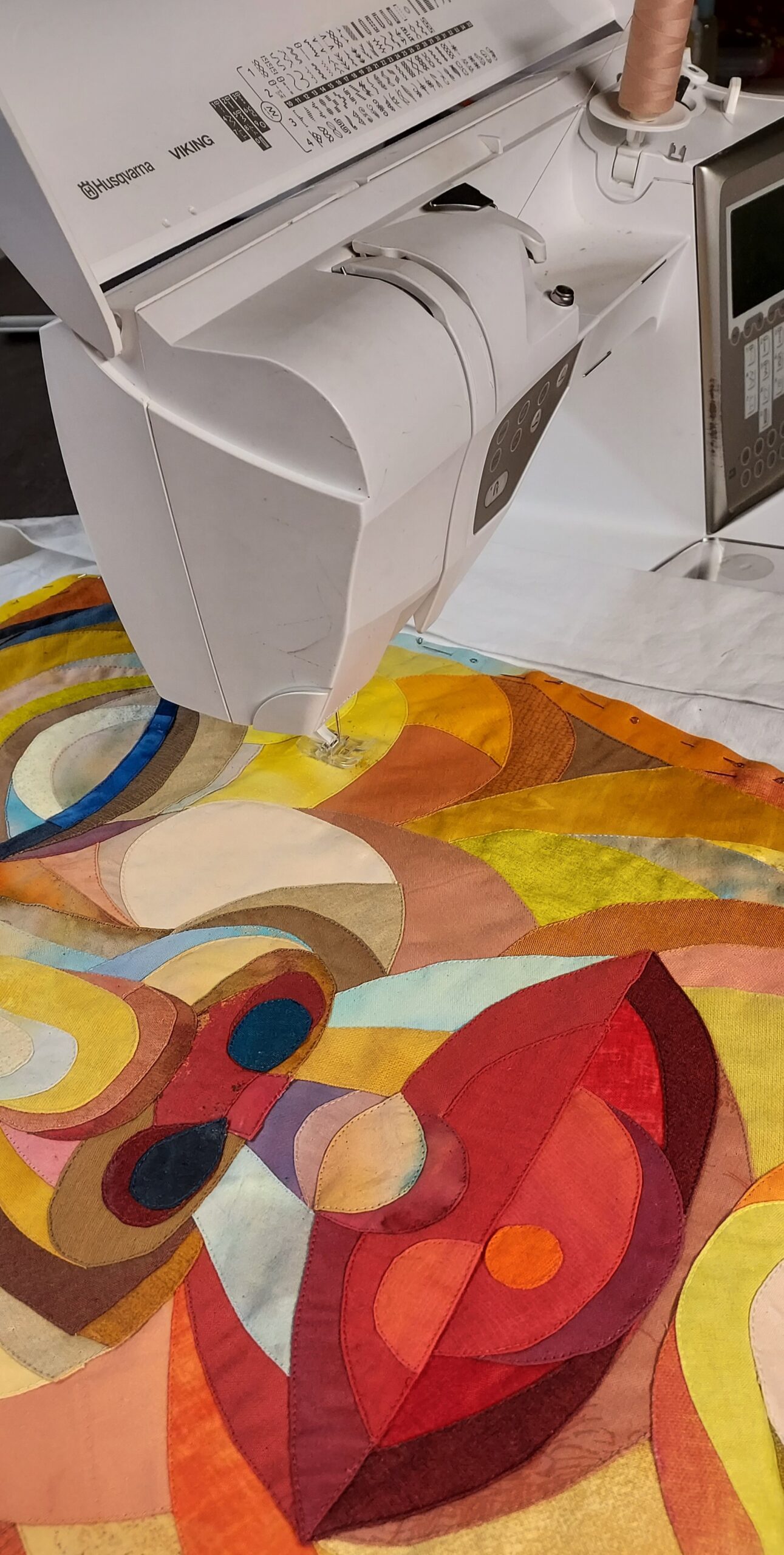
The work became very large, and made quilting all the layers difficult, especially with my old but beloved Husqvarna machine. Altogether, the work took me three months – three months of extraordinary life with an extraordinary woman. During that time, we communicated, studied one another and grew close.
Completion
After finishing the work, I could not find a space in my home large enough to hang it and see it from a distance. So, I set a chair three metres away and sat there for hours, losing all sense of time. My mind busily analyzed the piece, while I was engaged in an inner dialogue with the character. If this dialogue does not exist, the work has failed.
But Nefertiti winked at me with her right eye and seemed to say: “It’s fine. You succeeded.”
I packed her in a large box and sent her to Toronto. There, we met again. She looked magnificent: displayed against a black background, alone, without neighbours, she radiated all her colours. Visitors photographed her endlessly.
As I walked around the exhibition, people noticed my badge and asked: “Ah, is Nefertiti your work?” I nodded, and I saw admiration in their eyes. In that moment, I felt that despite centuries, distances and histories, she and I were one.